Silent Shark Guides
From your first hydrophone bearing to a clean convoy escape — step-by-step walkthroughs for the live 1.0 attack loop.
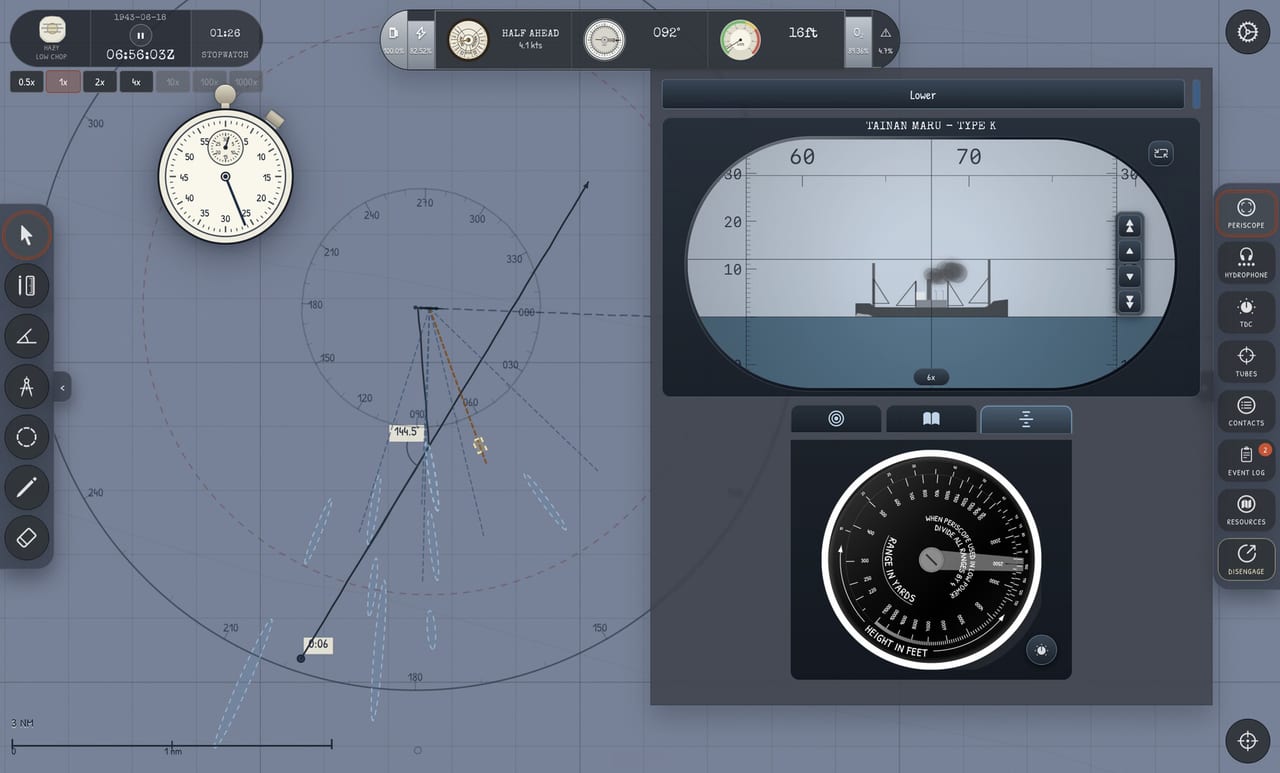
Welcome to the Guides Hub for Silent Shark, the map-based WWII Pacific submarine simulator from John Goering. Whether you are learning in the free demo or playing the August 12, 2026 full release on Steam, these guides explain the complete attack workflow: detect contacts, plot an intercept on the chart, identify targets through the periscope, estimate range with the stadimeter, build a firing solution in the TDC, and withdraw before destroyer escorts pin you down.
Silent Shark is single-player and deliberately instrument-focused. You are not steering a free-roaming 3D submarine; you command from the chart, hydrophone, periscope, and torpedo stations. That makes guides especially valuable on day one, because every mistake in bearing math or range estimation shows up as a missed torpedo or a depth-charge attack minutes later.
Where to start
New skippers should begin with the Getting Started guide, which mirrors the in-game Basic Tutorial and walks through chart tools, depth control, and your first plotted intercept. Once you can reach periscope depth with a reasonable track, move to How to Use the TDC for angle-on-bow (AoB), target speed, and Position Keeper workflow.
If bearings feel confusing, read Four Bearings Method before your next convoy. It is the standard technique for turning sparse hydrophone lines into a stable course and speed estimate. Pair that with Stadimeter Range Estimation so your TDC inputs are not built on guesswork.
Intermediate and survival guides
After you land a few hits in standalone encounters, study Evading Destroyers — escorts use hydrophone and sonar models that punish noisy depth changes and predictable evasion patterns. The guide covers when to go silent and slow versus hard and deep, and how thermal layers from Thermal Diving change your options.
First Patrol Walkthrough ties the individual skills into one coherent sortie: approach planning, commit criteria, tube setup, salvo choice, and egress routing on the chart. Pair it with Convoy Attack Doctrine when screens appear — both apply in the Demo generator and the live Pacific career.
New skipper pain points (2026)
Steam threads keep circling the same two skills. Use Angle on Bow Explained when Basic and Advanced tutorials feel contradictory, and Diving Cycles and Aircraft before the campaign adds denser air search. Both pages link into Binoculars and TBT and the scenario generator for drills.
Update the learning path: after TDC mastery, add AoB cleanup, then diving cycles, then first patrol with the Campaign Tutorial video.
Related hubs
Guides assume you understand the underlying stations. Cross-read these hubs when a step references an instrument you have not opened yet:
- Systems Hub — TDC, hydrophone, periscope, map tools, and thermal layers in detail.
- Controls Hub — keyboard and mouse bindings plus station switching habits that save seconds during an attack.
- Campaign Hub — patrol zones, radio intel, submarine classes, and resource management for the full Pacific career.
- Tools Hub — printable attack checklist and demo-versus-full comparison before you buy.
Suggested learning path
| Stage | Guide | Goal |
|---|---|---|
| Hour 1 | Getting Started | Complete a plotted intercept and first torpedo |
| Hour 2–3 | Four Bearings + Stadimeter Range | Reliable contact data for the TDC |
| Hour 4+ | How to Use the TDC | Consistent hits on merchant targets |
| Before convoys | Evade Destroyers | Survive escort counter-attacks |
| Hour 5 | Angle on Bow | Fix AoB tutorial confusion |
| Hour 6 | Diving Cycles | Surface/dive under air threat |
| Career | First Patrol + Convoy Attack | End-to-end sortie + screened columns |
Demo vs full game
The free demo (browser and Steam) includes tutorials, standalone encounters, and a limited scenario generator with core plotting, sensors, TDC, and torpedo systems. The full game adds the Pacific campaign, six submarine classes, complete scenario tools, historical events, and Steam achievements — all released on August 12, 2026. Use Demo vs Full Breakdown if you are deciding whether to buy.
Bookmark this hub and check Available Now and Updates Hub for patch notes after the 1.0 launch. For a broader look at design goals and platforms, see Review Hub.
Frequently Asked Questions
Quick answers to the most common Silent Shark questions.
Which Silent Shark guide should I read first?
Start with [Getting Started](/guides/getting-started/). It covers chart basics, depth control, and the first intercept loop that every other guide builds on.
Do these guides work in the free demo?
Yes. Tutorials, standalone encounters, and the limited scenario generator in the demo use the same TDC, hydrophone, and periscope workflow described here.
Is Silent Shark multiplayer?
No. Silent Shark is a single-player tactical simulator. All guides assume solo command from the chart and instrument stations.