Silent Shark Four Bearings Method
Turn repeated hydrophone bearings into course, speed, and a confident intercept track on the tactical chart.
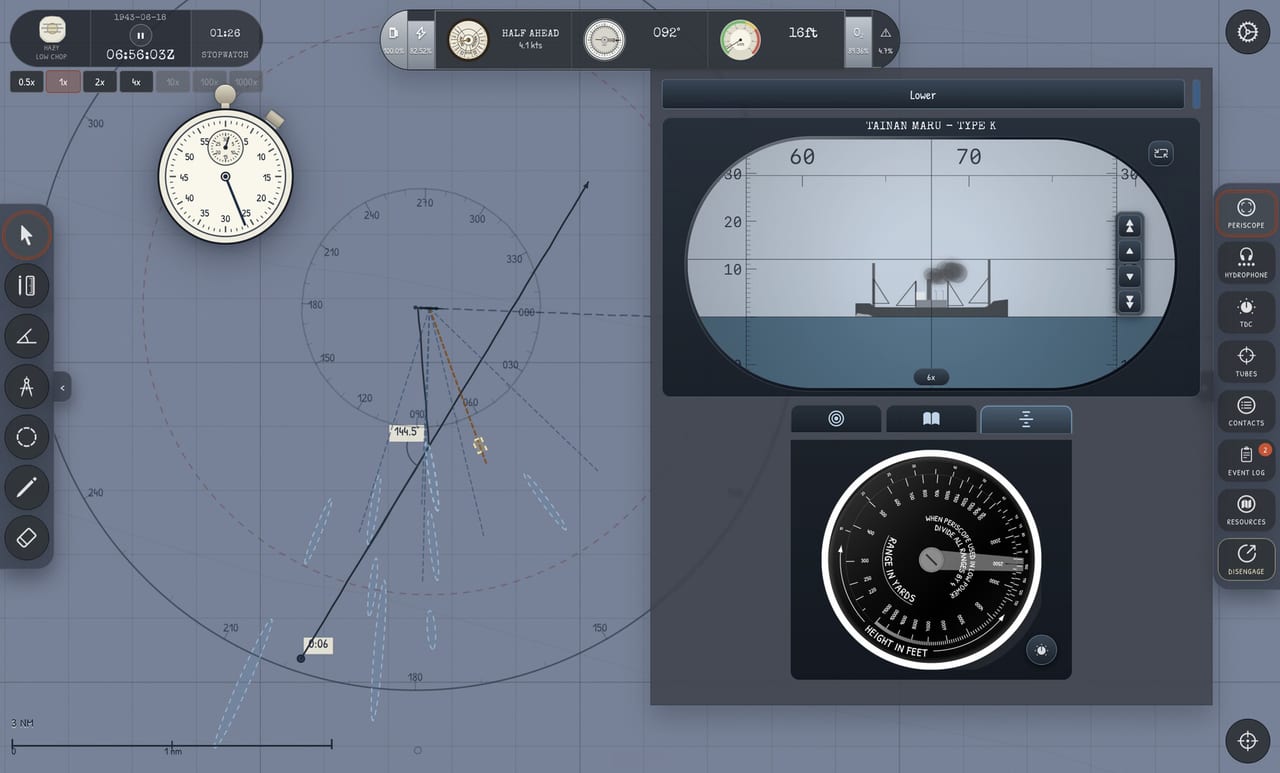
The Four Bearings Method is the standard Silent Shark technique for converting hydrophone observations into target course and speed before you commit to an intercept. It appears in the dedicated tutorial video on this page and underpins every advanced attack — convoy or single merchant — in both the demo and the August 12, 2026 full release.
Submarine captains rarely get radar-quality tracks. You get whispering bearings spaced by minutes. Four bearings (sometimes three if geometry is kind) let you draw lines of bearing on the chart, find their intersection or mean direction, and estimate speed from how fast the bearing moves relative to your own motion.
Why four bearings matter
Without course and speed, the TDC is guessing. You might still hit a slow tanker with a generous spread, but destroyer escorts will outmaneuver you while you re-solve. Four bearings give you:
- A stable target track to compare against your intended intercept leg.
- Early warning if the contact zigzags — common in convoy routing.
- Confidence to choose periscope depth approach vs abort when geometry never closes.
Pair this guide with Hydrophone Tracking for bearing quality and Map Tools for plotting mechanics.
Step-by-step procedure
1. Establish own-ship baseline
Mark your submarine position on the chart with a timestamp. Note your course and speed from the telegraph. Own-ship uncertainty poisons every subsequent line — if you turned without updating the chart track, fix that before taking bearing one.
2. Record bearing one
On hydrophone contact, note relative bearing and absolute bearing if the UI exposes it. Plot a line through your position at that bearing angle. Label time T0.
3. Advance time and record bearings two through four
Continue on a steady leg if possible — wild own-ship maneuvering complicates math. At roughly equal time intervals (three to five minutes works in demo scenarios), take bearings two, three, and four. Plot each line with timestamps.
4. Construct the target track
Lines of bearing from a moving target do not intersect at the target — they converge along the target’s motion vector. Silent Shark’s chart tools help you find the most consistent track that fits all four lines. The tutorial video demonstrates visual trial-fit; experienced players mentally average slight spread from hydrophone error.
5. Read speed and course
Once the track is drawn, measure course angle with the chart compass. Estimate speed by how bearing change compares to your movement over the observation window — faster targets swing bearing quickly when abeam. Enter results into the TDC via How to Use the TDC.
Quality checks before intercept
- Parallel lines — target course may match yours; intercept may require speed change.
- Fanning lines — target turning; refresh bearings before flooding tubes.
- Weak spread — extend observation; do not attack on three sloppy bearings unless demo difficulty is low.
Common errors
| Error | Symptom | Fix |
|---|---|---|
| Wrong own-ship track | All lines disagree | Re-mark turns on chart |
| Uneven time gaps | Speed estimate off | Use stopwatch station consistently |
| Single long leg only | No closure | Adjust course for better AoB |
| Ignoring escort pair | Sudden bearing jump | Identify merchants vs escorts by pitch |
Convoy considerations
Convoys present multiple hydrophone sources. Track the center merchant or the highest-value ship you intend to torpedo, not the nearest escort unless you enjoy depth charges. Merchant RPM sounds lower and steadier — see hydrophone page for pitch cues.
When bearings cross, expect destroyer search patterns after your first miss. Four bearings before commit reduces miss rate and therefore reduces escort rage.
From plot to periscope
Four bearings get you to commit range — the distance at which you descend to periscope depth and attempt visual ID. Switch to Stadimeter Range for the final range input before TDC lock.
Practice in the demo scenario generator: set clear weather, single merchant, generous start distance. Repeat until speed estimates land within a knot of truth when you finally raise the scope.
Related reading
- Getting Started — if you have not finished Basic Tutorial.
- First Patrol — integrates bearings into full sortie timing.
- Evading Destroyers — when bearings were right but egress fails.
Mastering four bearings separates players who hunt from players who hope. The skill transfers unchanged to the Pacific campaign at launch.
Frequently Asked Questions
Quick answers to the most common Silent Shark questions.
Can I use three bearings instead of four in Silent Shark?
Sometimes, when geometry is favorable and lines agree tightly. Four bearings reduce error before you commit to periscope depth and tube flooding.
How often should I take hydrophone bearings?
Every three to five minutes on a steady leg is a good default. Match intervals so speed estimation stays consistent.
Do four bearings work in the demo scenario generator?
Yes. Custom encounters use the same hydrophone and chart model as tutorials — ideal for repeating bearing drills.